
Keep the model you trust.
Remove the work around it.
Bring your financial data, budgets and assumptions into one connected planning environment — without starting again.
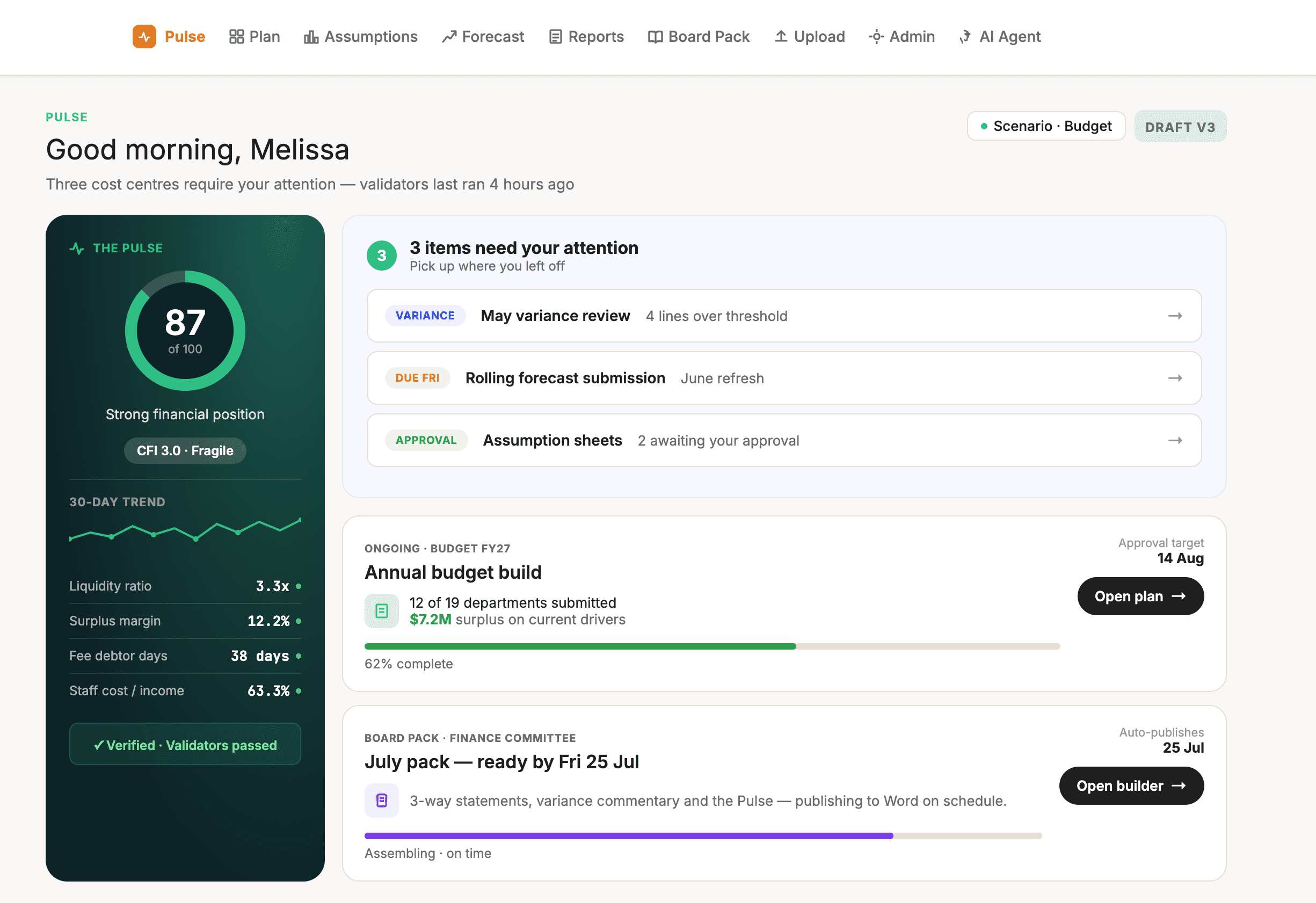
Start with existing financial data
No blank-page model rebuild.
Keep spreadsheet logic
Bring formulas and assumption models with you.
Work with the environment you already have
PULSE adds the planning layer around what works.
Keep the thinking behind
the numbers.
Behind the budget are enrolment models, staffing calculations, salary assumptions, fee models and the spreadsheets your finance team uses to work out what those numbers should be.
No blank-page rebuild. Existing workbook tabs, formulas and calculation logic can be brought into PULSE Assumption Sheets instead of being recreated manually.
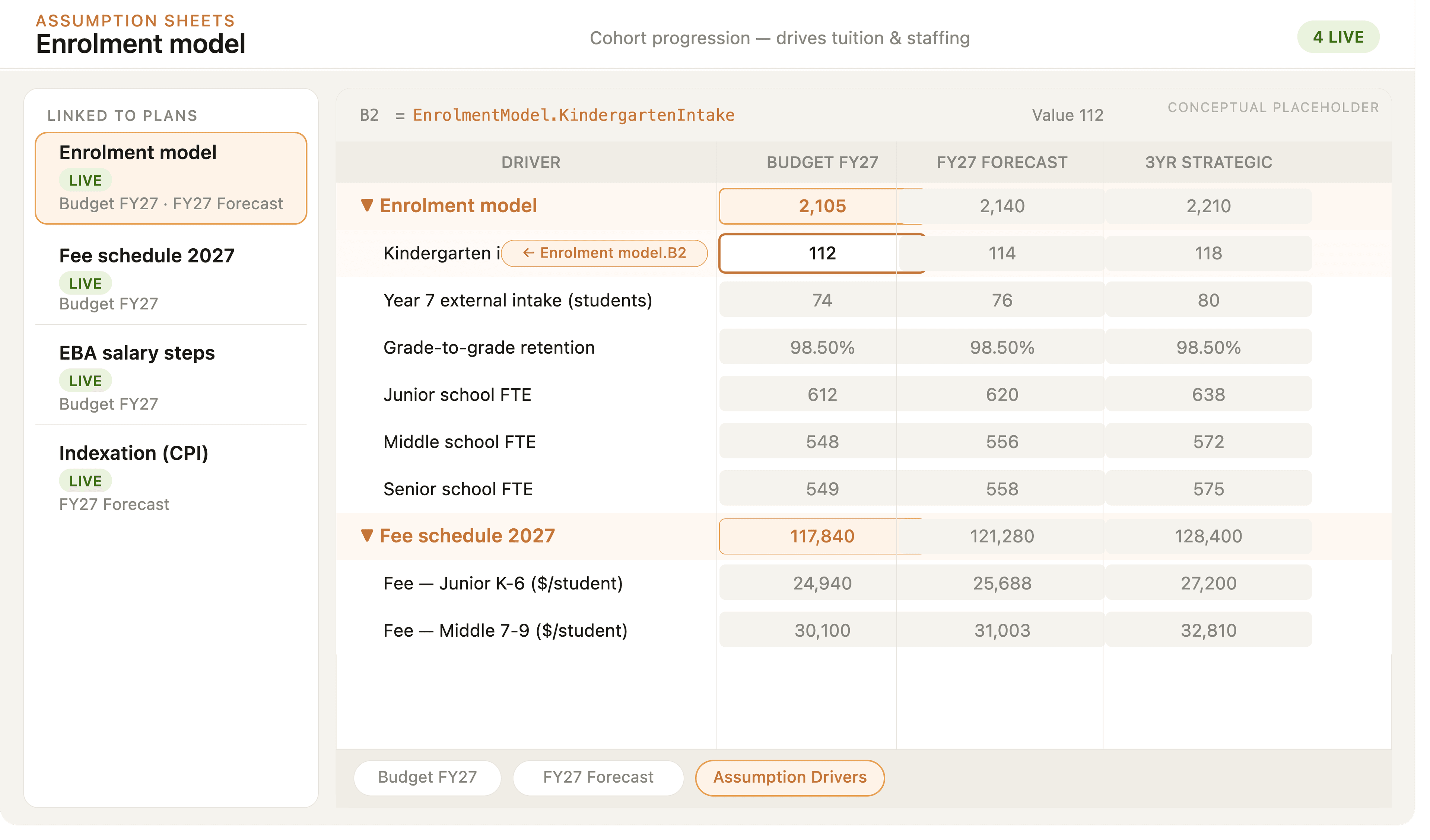
PULSE keeps the financial thinking. It changes the structure around it.
Bring planning, assumptions and financial analysis into one connected environment, while keeping the models and financial logic your school already understands.
Plan from the same financial structure.
Work with actuals, budgets and scenarios across the dimensions your school uses — from accounts and periods to departments, classes and locations.
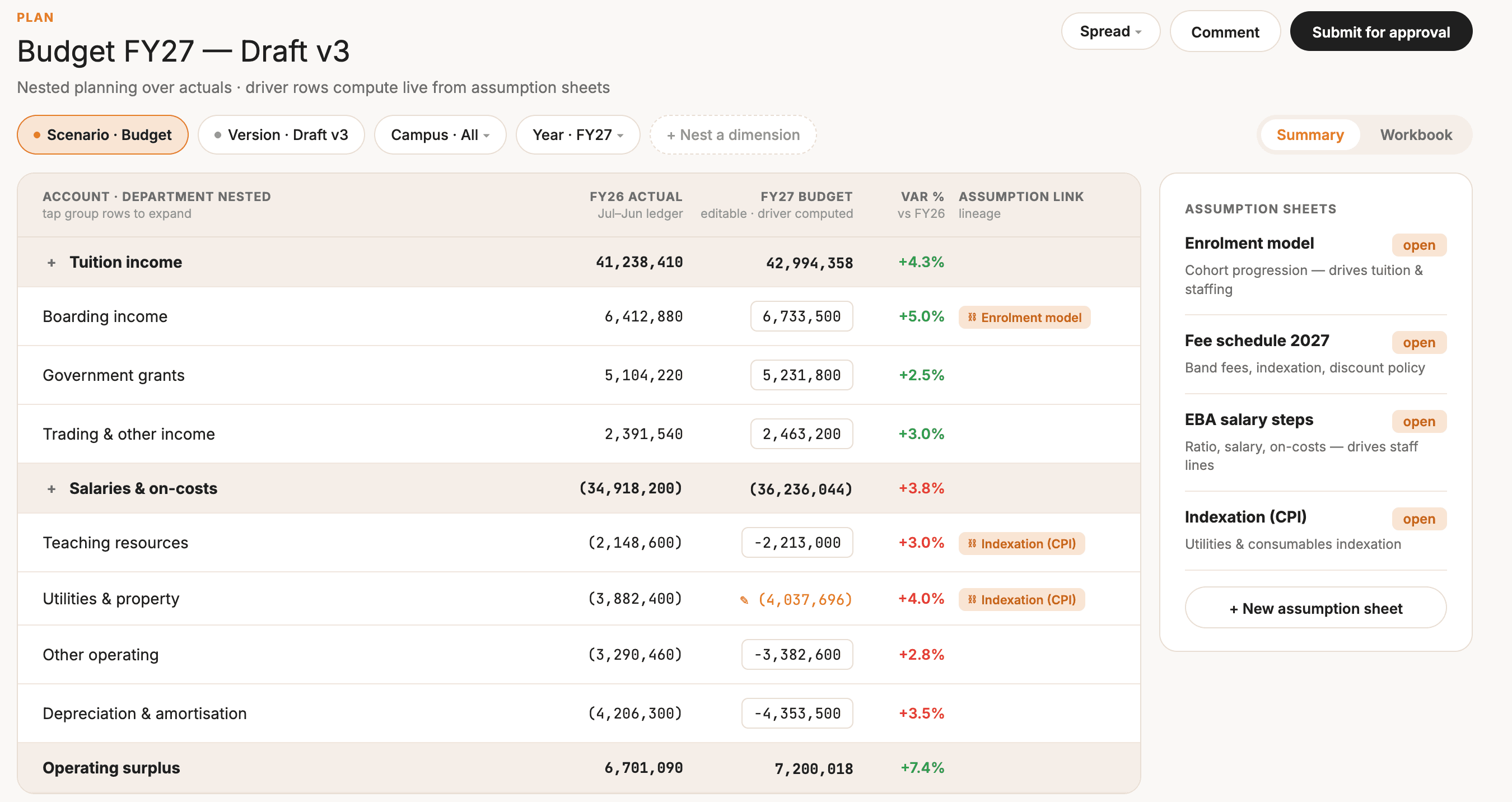
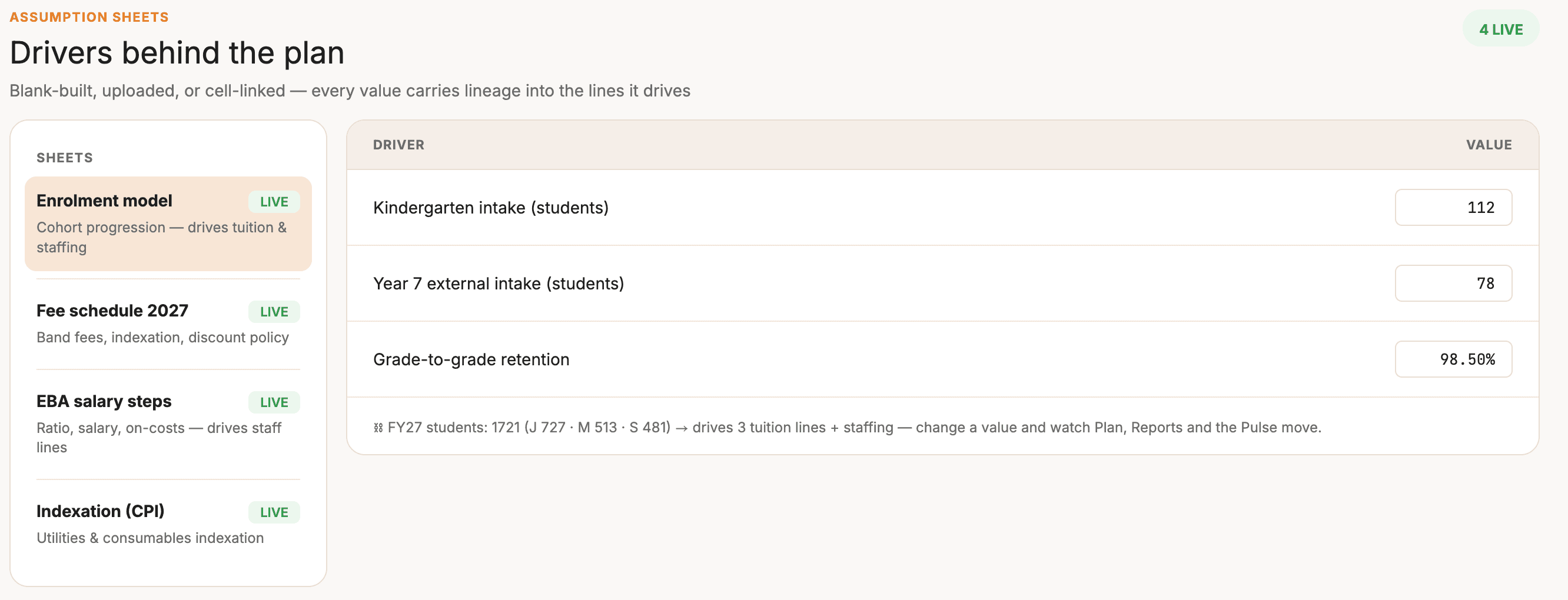
Change the assumption.
See where it lands.
Model the operational assumptions behind the budget and connect calculated outputs directly to the financial positions they drive.
Analyse the same financial reality from different views.
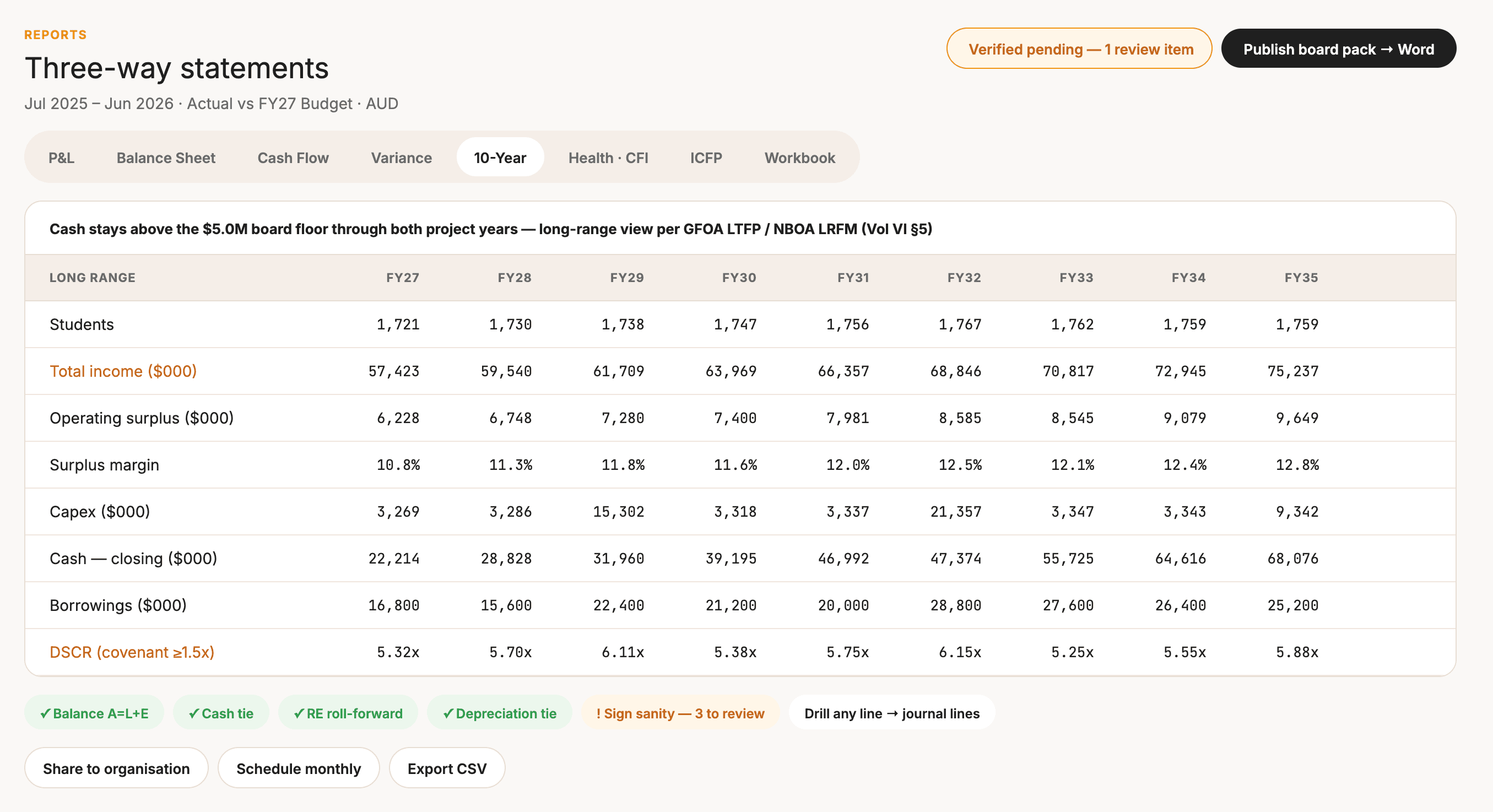
Move from financial statements to variance and dimensional analysis without creating another version of the model underneath the numbers.
Let budget holders do their part without breaking the model apart.
Give contributors a clear place to prepare their budgets and supporting assumptions while Finance keeps visibility of the process centrally.
Prepare & distribute.
Finance defines the relevant forms, access and budgeting areas, then distributes the work to contributors.
Work where the numbers and assumptions belong.
| Account | FY27 Budget | Status |
|---|---|---|
| Teaching supplies | 186,400 | Saved |
| Lab consumables | 94,200 | Saved |
| Equipment hire | 38,000 | Draft |
| PD & training | 22,500 | Draft |
| Total | 341,100 | Review |
| Account | FY27 Budget | Status |
|---|---|---|
| + Salaries & on-costs | (4,820,000) | |
| Recruitment | 68,000 | Saved |
| PD & conferences | 41,500 | Draft |
| Staff wellbeing | 28,200 | Draft |
| Total | (4,957,700) | Review |
| Account | FY27 Budget | Status |
|---|---|---|
| Utilities & property | (4,037,696) | Saved |
| Cleaning services | 312,800 | Saved |
| Maintenance | 198,500 | Draft |
| Security | 86,000 | Draft |
| Total | (5,634,996) | Review |
See the process centrally.
Finance can monitor work in progress, review submitted forms and return them for changes where required.
Controlled input
Budget holders work within the areas relevant to them.
Context stays with the numbers
Notes and supporting assumptions remain alongside the budgeting work.
Work doesn't disappear
Draft work remains available as contributors build their budgets.
Finance stays connected
Finance can monitor work, review submissions and return forms for changes.

One financial model. Many questions answered.
Move between summary and detail, keep the source behind the numbers visible and work with planning scenarios from the same financial structure.
Visibility
Move from summary to detail across the dimensions the question requires.
Traceability
Keep imported financial information and supporting context accessible.
Scenarios
Maintain different planning scenarios within the model.